
Calories Burned Walking by Weight: How Body Weight Affects Calorie Burn
TRACK STEPS.
Fitbit Charge 6GPS & Heart Rate
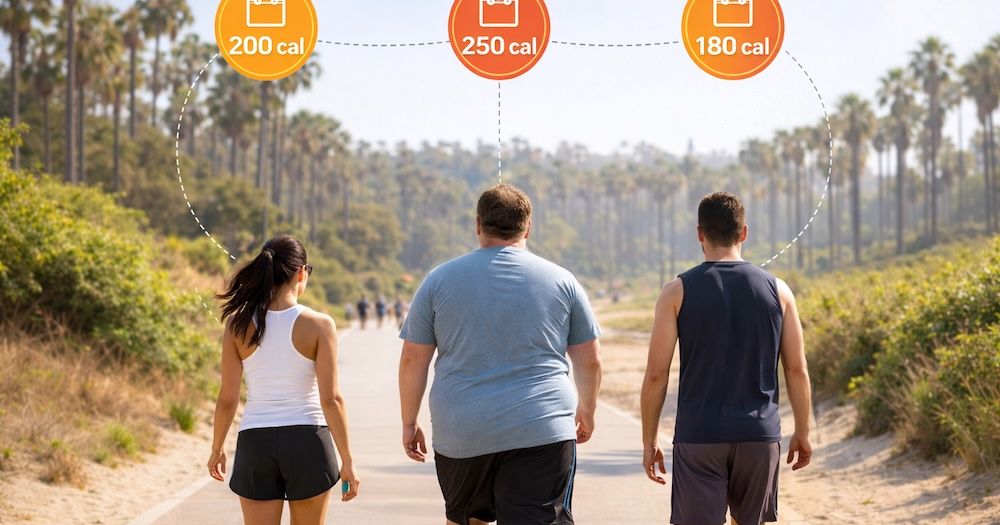
Body weight is one of the most important factors in determining how many calories you burn while walking. Two people can walk the same number of steps at the same pace and burn very different amounts of calories.
This guide explains how body weight affects calorie burn, provides estimated ranges for different weights, and helps you understand how many calories you may burn from walking.
Why Body Weight Changes Calorie Burn
Walking requires energy to move your body mass across distance. The more mass you move, the more energy your body uses.
This means heavier individuals typically burn more calories per step compared to lighter individuals.
However, walking speed, incline, and total duration still matter.
Estimated Calories Burned Walking 10,000 Steps by Weight
Table: Estimated Calories for 10,000 Steps (Moderate Pace)
- 120 lbs: 250 to 300 calories
- 140 lbs: 280 to 350 calories
- 150 lbs: 300 to 400 calories
- 180 lbs: 400 to 500 calories
- 200 lbs: 450 to 550 calories
- 250 lbs: 550 to 650 calories
- 300 lbs: 650 to 800 calories
These are general estimates for flat terrain at a moderate walking pace.
Calories Burned Per 1,000 Steps by Weight
On average, calorie burn per 1,000 steps may look like this:
- 120 lbs: 25 to 30 calories
- 150 lbs: 30 to 40 calories
- 200 lbs: 45 to 55 calories
- 250 lbs: 55 to 65 calories
- 300 lbs: 65 to 80 calories
These numbers increase with brisk walking or incline.
How Walking Speed Changes Calorie Burn
Walking slowly burns fewer calories per minute. Increasing speed raises your metabolic rate.
A brisk pace where you can talk but not sing is generally more effective for calorie burn than a relaxed stroll.
Incline Walking and Body Weight
Incline walking increases energy expenditure for all body weights. Heavier individuals experience an even greater calorie increase when walking uphill due to the added resistance.
Even a small incline can significantly increase total calorie output.
How Many Steps Should You Walk Based on Your Weight?
If your goal is weight loss, the number of steps required depends on your daily calorie target.
For example, if you weigh 200 lbs and want to burn 500 calories from walking, you may need roughly 8,000 to 11,000 steps depending on pace.
A 140 lb individual may need closer to 12,000 steps to burn the same amount.
Using a Calculator for Personalized Results
Tables provide estimates, but they do not account for stride length, speed, terrain, or metabolic efficiency.
For more accurate results, use a steps to calories calculator and input your body weight directly.
Frequently Asked Questions
Do heavier people burn more calories walking?
Yes. Moving greater body mass requires more energy, which increases calorie burn per step.
Do lighter people need more steps to lose weight?
Often, yes. Because lighter individuals burn fewer calories per step, they may need more total steps to reach the same calorie deficit.
Does weight loss change calorie burn?
Yes. As you lose weight, your calorie burn per step decreases slightly because you are moving less mass.
Final Thoughts
Your body weight plays a major role in how many calories you burn while walking. Understanding this helps you set realistic step goals and calorie targets.
For precise planning, combine your body weight with your daily step count using a reliable calculator instead of relying only on averages.
Track consistently, adjust gradually, and focus on sustainable progress.